ERP System for a Logistics Company
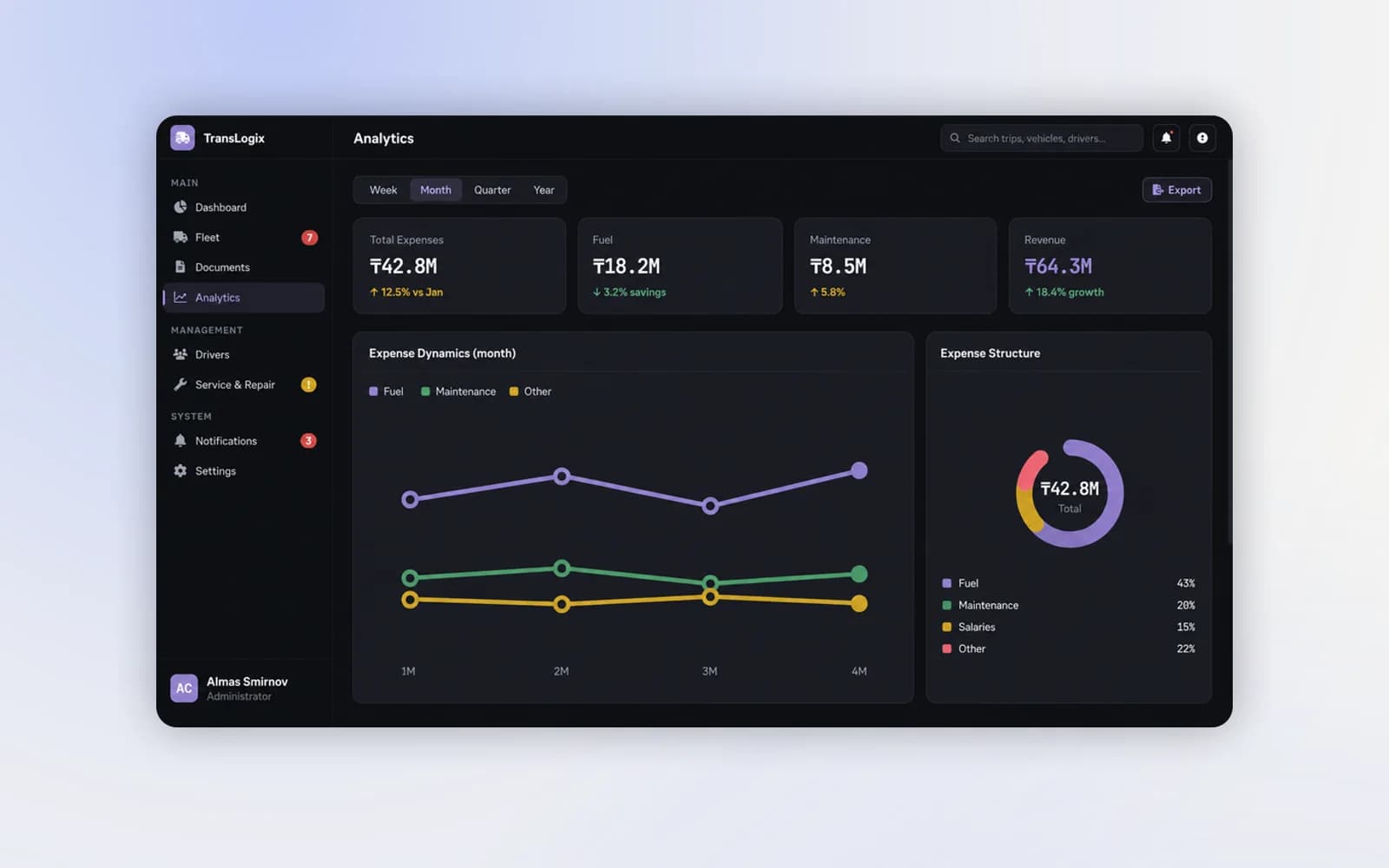
We combined fleet monitoring, document management, finance, and day-to-day operations into a single ERP system.
- Client
- Logistics company (name withheld under NDA)
- Product
- ERP web platform
- Our role
- Design and development
- Status
- In production
- Delivered
- Role interfaces: director, dispatcher, accountant, driverGPS tracking integrationERP integrationTelegram bot for driversDocuments, trip statuses and KPIs recorded automatically
About the project
At the logistics company, data was spread across monitoring tools, Excel, the ERP, and messengers. Management couldn't see the full picture, dispatching was slow, and documents and KPIs were compiled with errors.
We built an ERP system that brought the entire shipping cycle into one place — from a truck's departure to closing documents and driver incentive calculations.
Metrics and impact
What changed for the business after launch.
Trips, statuses, and documents come together in the ERP without manual reconciliation between departments.
GPS tracking, routes, and KPIs help spot deviations faster and manage vehicle utilization.
Management sees finance, trips, and documents in one environment instead of manual summaries.
What changed in day-to-day work
- Director, dispatcher, accountant and driver work in one system instead of monitoring tools, Excel and messengers
- Routes, idle time and trip statuses are recorded automatically via GPS
- Driver KPIs are calculated automatically, without disputes
Technical highlights
The platform is built around the roles of a transport business: director, dispatcher, accountant, and driver each work in their own interface but within a single data environment. The director sees analytics, the dispatcher sees trips and load, and accounting sees documents and calculations.
We connected the system to GPS tracking, the ERP, and a Telegram bot for drivers. Routes, idle time, documents, and trip statuses are recorded automatically, so the company gets a transparent operational process rather than a set of disconnected actions.
Results
The company got a single system instead of a set of disconnected tools and manual workarounds.
Driver KPIs are now calculated automatically and transparently, without subjectivity or disputes.
Document workflows sped up, errors dropped, and the workload on accounting fell noticeably.