AI voice agent
AI voice agent development for the calls your team takes every day
An AI voice agent picks up the phone, understands what the caller wants and does something about it: it books the slot, checks the order, takes the message or puts the call through to the right person. We build it around your process, your rules and your systems, not around a demo script.
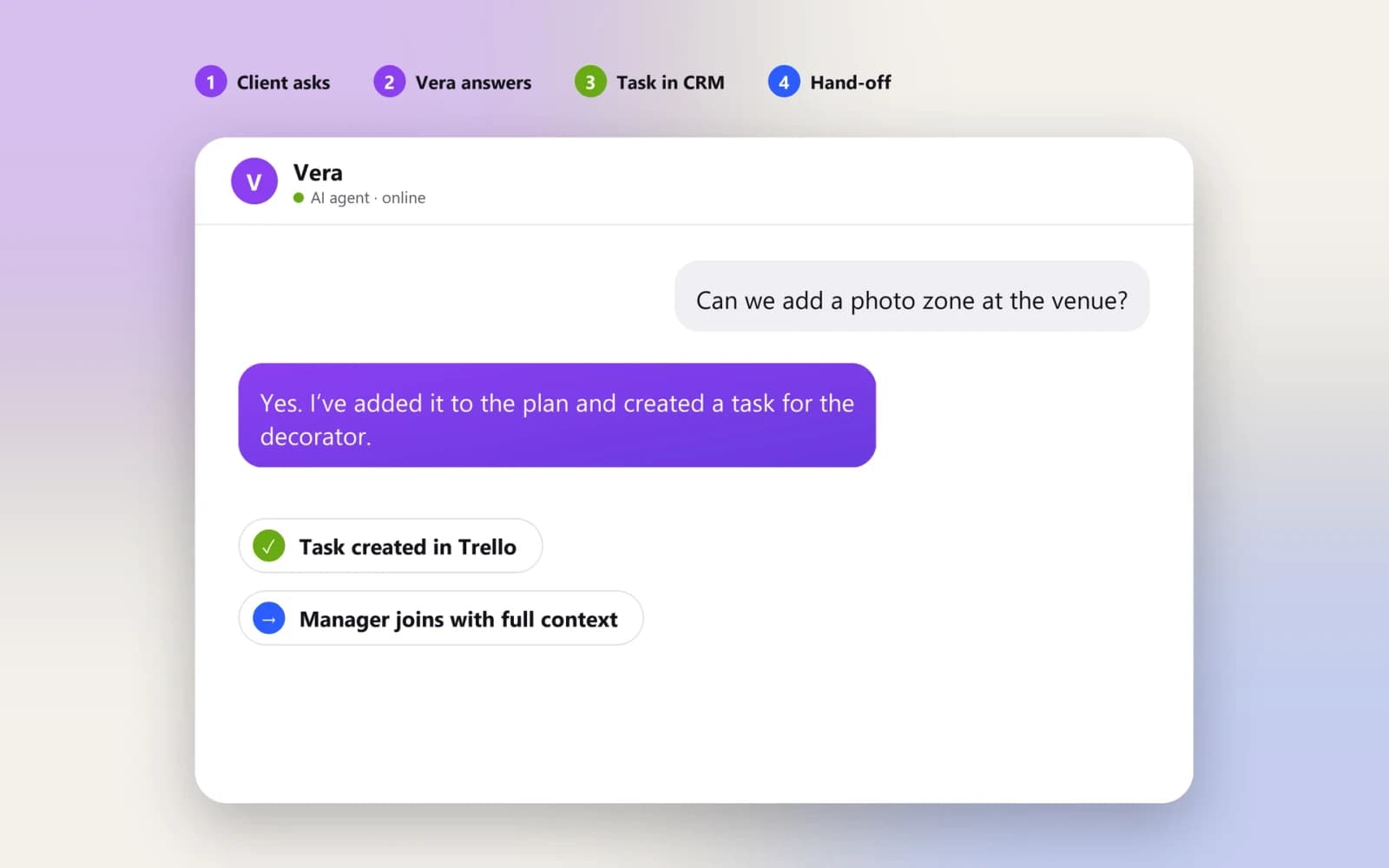
The same agent logic, in chat.
Ask it anything. On a voice line the agent understands the request, acts in your systems and hands over to a person the same way.
It’s live — try it right here, nothing saved.
What it does on a call
Answers inbound calls and understands the request
The caller speaks in their own words. They don’t have to press 1 for bookings. The agent understands the request, asks what it needs to know, one question at a time, and answers from your approved information: hours, prices, policies, order status. If it doesn’t know, it says so and routes the call. It doesn’t guess.
Acts in your systems while the caller is on the line
A useful voice agent does more than talk. Through your systems’ APIs it can check availability and book a slot, find an order by number, create a ticket or a task, or write a lead into the CRM. The caller gets an answer on the same call, and your team finds a record instead of a sticky note.
Makes the calls you already make
Confirmations, reminders, “your order is ready”, a follow-up to someone who asked to be called back. These are outbound calls to people who expect to hear from you. The agent can make them on a schedule, handle the reply and log the outcome. Cold calling to purchased lists is a different scope and not what this page offers.
Hands the call to a person, with context
The caller asks for a human, the topic is outside the rules, or the caller sounds upset. In any of these cases the call is transferred, or a callback is booked. Your team gets the transcript and a short summary, so nobody asks the caller to repeat themselves.
Where voice pays off
Voice makes sense where calls are frequent, similar to each other and followed by a clear action. Typical cases:
- Appointment lines. Booking, rescheduling and cancelling for clinics, salons and studios. If that is the whole job, see our AI receptionist page: it is the same technology, packaged for a front desk.
- Order and delivery status. “Where is my order?” answered from your order system, with a hand-off when something has gone wrong.
- After-hours and overflow. The agent takes the calls your team can’t: at night, at weekends, or when all lines are busy. It takes the details and books a callback.
- Inbound enquiries. It collects what a salesperson needs and books the call. For the same flow in chat, email and WhatsApp, see the AI sales agent.
- Reminders and confirmations. Fewer no-shows and fewer “did you get my order?” calls, because the agent calls first.
- Internal lines. Field staff report a job done or a problem by phone, and the agent turns the call into a structured record.
Some of these don’t need voice at all. If most of your customers would happily write, a chat agent is cheaper to run. That is what our AI chatbot for website and customer service page covers. We’ll tell you which one fits.
How an AI voice agent works
Behind every voice agent, whichever platform it runs on, there are the same five parts. Knowing them makes it easier to compare offers.
- 1
Telephony
A phone number, or call forwarding from the number you already have. The call reaches the agent over a SIP trunk or through the platform’s own telephony.
- 2
Speech-to-text
The caller’s speech is turned into text as they speak. Accents, background noise and names are where the quality of this step shows.
- 3
The language model with your rules
It reads the transcript, decides what the caller wants and what to say next. It is limited to your approved information and the actions you allow.
- 4
Tools
API calls to your calendar, booking or order system, CRM or help desk. This is where the agent does real work, and where most of the build effort goes.
- 5
Text-to-speech
The reply is spoken back in a voice you choose, fast enough that the pause feels natural.
The hard part is rarely the voice. It is the timing (answering without long silences, letting the caller interrupt), the edge cases (a caller who changes their mind halfway) and the integrations. A demo on a platform can be ready in an afternoon. An agent that handles your real calls needs your data, your rules and testing on real conversations.
Voice platform or a custom build: how to choose
Platforms such as Retell, Synthflow, ElevenLabs and Telnyx give you the building blocks: telephony, speech, a model and a visual editor. Depending on the job, you can use one on your own, have one set up for you, or build your own stack.
Good for
- Do it yourself on a platform
- A simple script: answer FAQs, take a message
- A platform, set up and integrated by us
- A real process with bookings, orders or CRM
- Custom stack
- Unusual telephony, strict data rules, high call volume
Integrations
- Do it yourself on a platform
- What the platform offers out of the box
- A platform, set up and integrated by us
- Your calendar, CRM, order system through their APIs
- Custom stack
- Anything with an API
Who owns the logic
- Do it yourself on a platform
- You, in the platform’s editor
- A platform, set up and integrated by us
- You. It runs in your accounts, and we hand it over documented
- Custom stack
- You. The code is handed over under your agreement
Running costs
- Do it yourself on a platform
- Platform per-minute pricing
- A platform, set up and integrated by us
- Platform and model usage at cost, listed separately
- Custom stack
- Telephony, speech and model usage at cost, plus hosting
Main risk
- Do it yourself on a platform
- Hits the limits of the editor as soon as the process gets real
- A platform, set up and integrated by us
- Depends on the platform’s roadmap and pricing
- Custom stack
- Longer first release
We choose the approach in the scope, before development begins, and write the reason down. If a platform on its own is enough for your case, we’ll say so.
AI voice agent cost
The estimate depends on how many call types the agent handles and how long each conversation is; the systems it reads and writes (calendar, booking or order system, CRM, help desk); inbound only, or inbound plus scheduled outbound calls; the languages it speaks, since each one is tested separately; and the platform or stack chosen in the scope.
Telephony, speech and model usage are billed at cost and listed separately from the development price, so you can see what one minute of a call costs you. Number setup and call testing are part of the build.
Six-month warranty. Coverage and ongoing support are set out in your project agreement.
What the first build includes
- One phone line: your number forwarded, or a new number
- One call flow: the type of call the agent handles end to end
- Your approved information and your rules for what it may do alone
- One integration: calendar, booking or order system, or CRM
- Hand-off to your team with transcript and summary
- Testing on your real example calls before launch
From your call log to a live line
Tell us which calls to automate
Send us a few typical calls: recordings, transcripts or just a description. Tell us what your team does after each one. A short message is enough to start.
Agree the scope and quote
We define which calls the agent takes, what it may do on its own, when it hands over, and which systems it connects to. You get the price and the delivery plan before development begins.
Build and test on real calls
We write the agent’s instructions and knowledge base, connect the tools and run it against your example calls. You call it yourself before any customer does.
Launch and hand over
We start with a share of the calls, for example after hours or overflow only. Your team reads the transcripts in the first weeks, and the rules are tuned on what real callers say. Then the project is handed over as set out in your agreement.
A first voice agent goes live once your information, rules and system access are ready; the delivery date is fixed in the agreement.
Our AI agent work
We build AI agents that talk to customers, act in business tools and bring a person in at the right moment. Voice calls are a new channel for the same kind of agent.
Calls, data and honesty with callers
- The caller knows it’s an AI. The agent introduces itself and transfers to a person whenever the caller asks.
- Recording and transcripts. Whether calls are recorded, and how callers are told, follows the rules in your country and your policy. We set it up in the scope.
- Personal data. It is handled under GDPR, with EU hosting available. The agent reads and writes only the systems listed in the scope.
- Your accounts. The number, the platform account and the integrations run in your name, so you are not locked in to us.
The stack we build with.
One team, six crafts.
Fair questions, straight answers.
Send us one call your team takes every day
A recording, a transcript or three lines describing it are enough. We’ll tell you whether a voice agent is worth it for that call, which approach fits and what it will cost to build and to run.