AI sales agent
An AI sales agent that answers every lead in seconds
A lead who writes at 11 pm and hears back at 10 the next morning has usually written to someone else in between. The agent replies at once — on the website, by email, in WhatsApp — asks what you would ask, qualifies against your rules, books the meeting in your calendar and writes it all to the CRM. Your team walks into calls that are already warm.
- Telegram
Move a lead. Watch the follow-up happen.
Drag a deal to the next stage: the welcome email goes out, the task lands with the right person, the proposal is generated, the invoice is raised. The agent does the same the moment a lead writes.
It’s live — try it right here, nothing saved.
- Nothing yet. Move a card forward — every step fires real-world actions.
What the agent does with a lead
Answers first, in seconds, in your tone
Website chat, contact form, email, WhatsApp — whichever way a lead arrives, the agent replies at once with a real answer to what they asked, not an autoresponder. It knows your services, prices, timelines and cases, and says so in your voice.
Qualifies against your rules
Budget, timeline, decision maker, fit: the agent asks what you would ask, one question at a time, and scores the lead against the criteria you set. Good fits are booked; poor fits get a polite, useful answer; edge cases go to a person.
Books the call and keeps the CRM current
The agent offers slots from your calendar, books the meeting, sends the confirmation and writes the conversation, the qualification and the next step to the CRM. Nobody re-types anything, and nothing waits until morning.
Follows up when a lead goes quiet
Someone asked for a price and went silent. The agent follows up on a schedule you set, in the channel the lead used, and stops when they answer or after your last step. Every message is logged, so your team sees the whole thread before the call.
Who it is for
An AI sales agent earns its keep where leads come in faster than a small team can answer, and where the first conversation is mostly the same questions. Typical cases:
- Service businesses with a quote step. Agencies, studios, contractors, consultancies. The lead wants a rough price and a date. The agent gives the ranges you approve, asks what affects the quote and books the call where the real estimate is made.
- B2B companies with inbound demand. Demo requests and contact forms that sit until a rep gets to them. The agent answers, checks fit against your criteria and books the demo with the right person.
- Businesses that sell in messengers. Leads who write in WhatsApp or Telegram expect an answer in minutes, not the next working day. The agent answers there, in the same thread.
- Teams that lose leads after hours. Evenings, weekends, time zones. The agent covers the hours when nobody is at the desk, and the morning starts with booked calls instead of a pile of messages.
Your process, made instant
We start from how your best salesperson handles an inbound lead today — the questions, the order, the answers to objections, when a call is offered. That conversation becomes the agent’s script; your service pages, prices and cases become its knowledge base.
Rules set what the agent decides alone and what it hands over: a budget under your minimum, a request outside your services, a lead who asks for a person. Every conversation is logged to the CRM with a summary, and the first weeks run with your team reading the transcripts.
The agent runs on the channels you use and in your accounts — website, email, WhatsApp, Telegram — connected to your calendar and CRM through their APIs. It is the same kind of agent that greets visitors on this site.
AI sales agent, chatbot or a contact form?
All three sit where the lead arrives. They do very different amounts of work.
First reply
- Contact form + autoresponder
- “Thanks, we’ll get back to you”
- Rule-based chatbot
- Instant, from a fixed menu
- AI sales agent
- Instant, a real answer to what was asked
Questions it can handle
- Contact form + autoresponder
- None
- Rule-based chatbot
- The ones in the script
- AI sales agent
- Anything covered by your services, prices and cases; the rest goes to a person
Checking fit
- Contact form + autoresponder
- Your team, later
- Rule-based chatbot
- Buttons and fixed branches
- AI sales agent
- A conversation against your criteria, with a score and the reasons
Booking
- Contact form + autoresponder
- Your team, by email
- Rule-based chatbot
- A calendar link
- AI sales agent
- Offers slots, books, confirms
CRM
- Contact form + autoresponder
- Manual entry
- Rule-based chatbot
- Sometimes a new contact
- AI sales agent
- Conversation, answers, score and next step written to the CRM
When it’s enough
- Contact form + autoresponder
- Very few leads, long sales cycle
- Rule-based chatbot
- Simple, repeatable requests
- AI sales agent
- Enough leads that speed and follow-up decide who wins
A rule-based bot is cheaper and sometimes the right answer. We’ll say so if it is. See chatbot development for that route.
What the agent doesn’t do
- It doesn’t close the deal. Pricing exceptions, negotiation and the final yes stay with your people. The agent’s job is to get a well-prepared lead into that conversation fast.
- It doesn’t cold-message lists. It works with people who came to you. Outbound to cold lists is a different scope and not what this page sells.
- It doesn’t invent answers. It speaks from your approved information. A question outside it is handed over, and the gap is listed so it can be covered.
- It doesn’t hide that it’s an AI. It introduces itself and hands over the moment a lead asks for a person.
For a wider look at which sales tasks to give to AI first, and how to measure the result, read our guide AI for sales teams: what to automate first. It covers lead qualification, CRM entry, follow-ups and a rollout plan for a small team.
AI sales agent cost and timing
The estimate depends on the channels, the CRM and calendar integrations and how much of your sales conversation the agent has to cover. Model usage is billed at cost and listed separately.
A first agent can be live from around three weeks once your service descriptions, prices, qualification rules and a sample of past lead conversations are ready.
Six-month warranty. Coverage and ongoing support are set out in your project agreement.
From first message to launch.
Tell us what needs to work
Share the goal, the users and any systems you already use. A short message is enough to start.
Agree the scope and quote
We define the first release, responsibilities, price and delivery plan before development begins.
Review the build
You see the agreed screens and working flows as the project develops. Changes are assessed before extra work starts.
Launch and hand over
We prepare the release, test the agreed flows and hand over the project as set out in your agreement.
Projects behind it
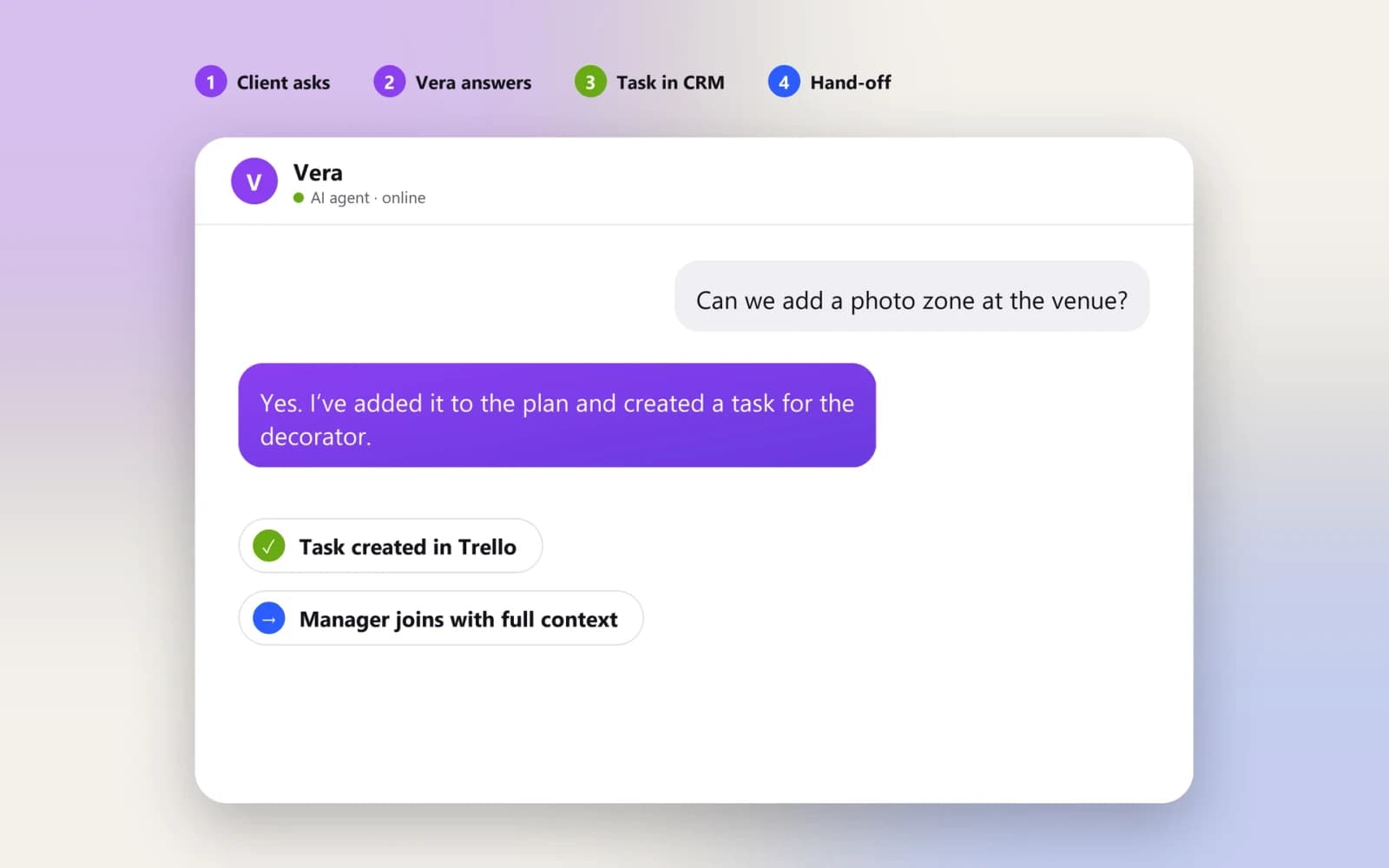
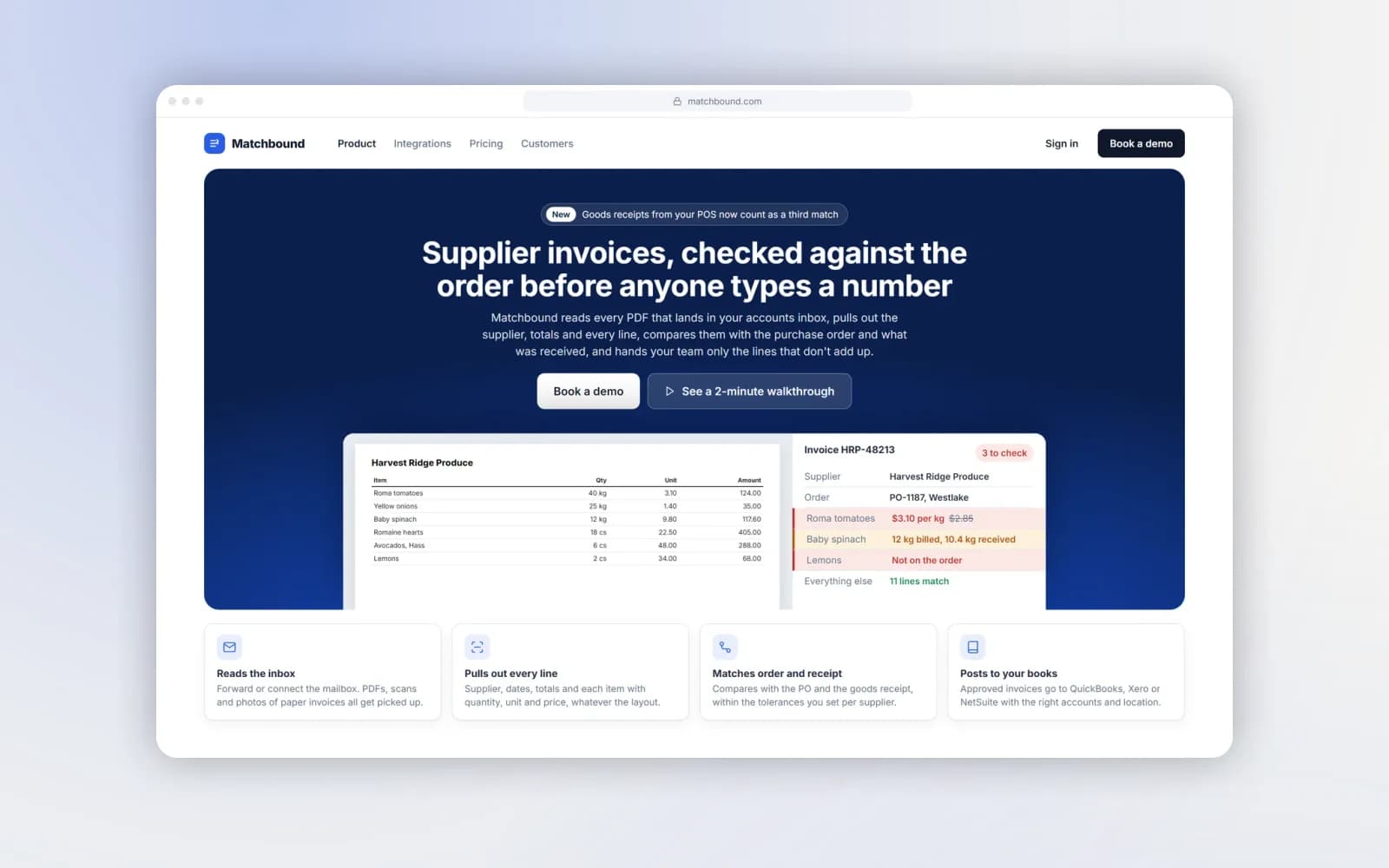
Vera takes over a wedding agency’s daily conversations and brings the manager in only when it matters; Matchbound turns an inbox of invoices into decisions with a person only where the numbers disagree. Both are the pattern a sales agent follows: instant, grounded, handed over at the right moment.
The stack we build with.
Fair questions, straight answers.
Show us how you answer a lead today
Send a few real lead conversations and the questions your team asks before offering a call. We’ll turn them into the agent’s script, name the integrations and estimate the work.