
Online shops and B2B stores for Munich firms
A Munich store may sell components to engineers, reagents to research groups or the first batch of a startup’s device.
More
We build stores from €2,500, with catalogue, prices per customer, checkout and orders in one admin.
Munich sellers a standard shop builder does not fit
Each of these stores needs something a template handles badly: part numbers, approvals, pre-orders.
- 01Components after a trade fair
Engineers met at electronica or productronica order small batches by email, quoting part numbers, and wait for a manual quote.[1]
A B2B store with part-number search, datasheets, volume prices and customer accounts, showing stock before anyone asks and issuing an e-invoice with each order.
- 02Lab supplies for research groups
Institutes order reagents and consumables by email, need a purchase order number on every invoice and a sign-off from the group leader before anything ships.[2]
Institute accounts with approval steps, order numbers printed on each invoice, and repeat orders from past baskets in one click.
- 03A startup’s first hardware batch
Pre-orders run through a crowdfunding page that keeps the customer data, and the team answers delivery questions one by one.[3]
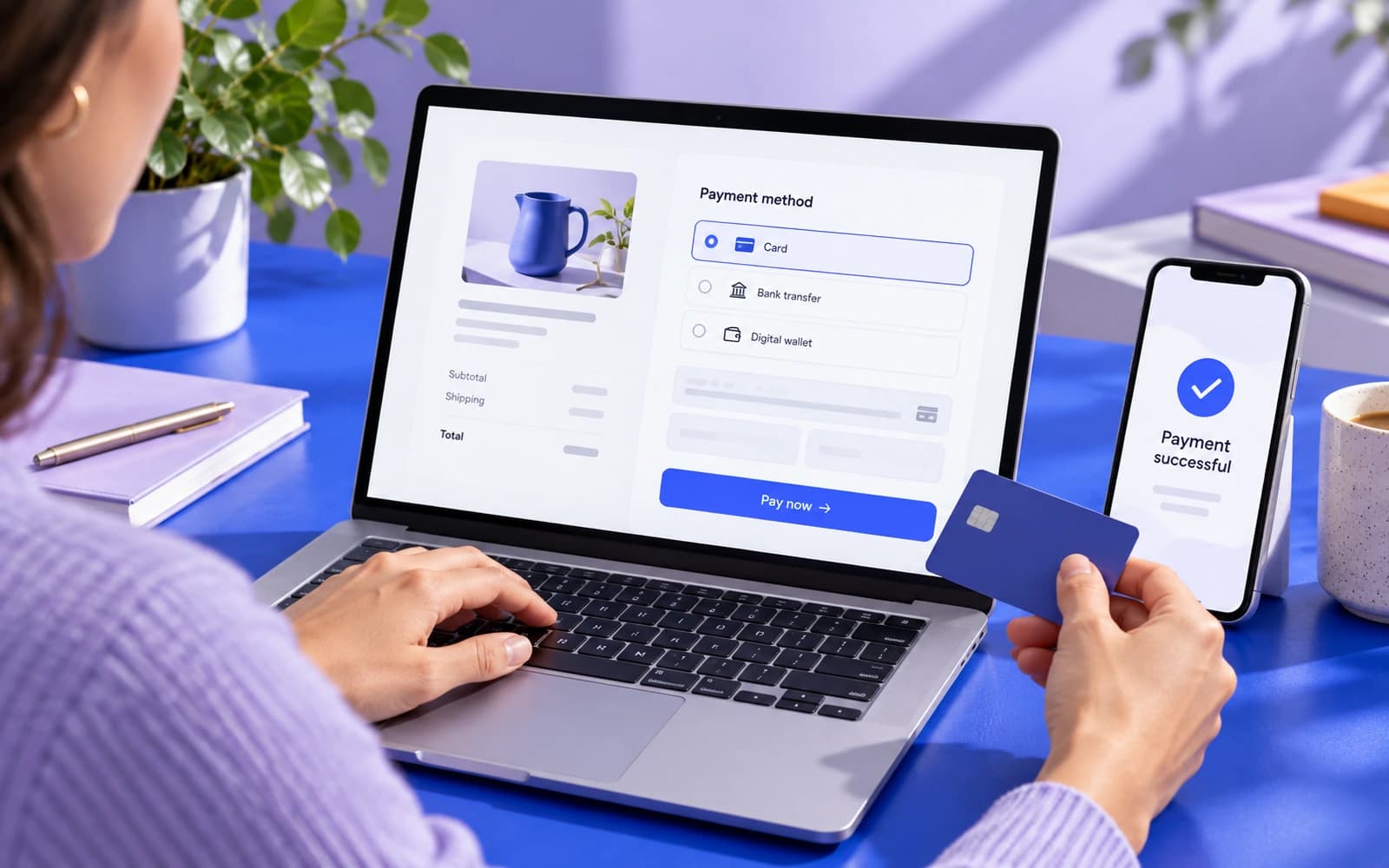
Your own store with pre-orders, delivery updates and PayPal and cards at checkout. The customer list stays with you for the second batch.
Projects we can show you
Paying and invoicing in a German store
Online buyers in Germany mostly reach for PayPal, and business buyers bring e-invoice dates with them. Settle both before the catalogue goes live.
- Cash and debit cards
- girocard
- PayPal
- Apple Pay and mobile wallets
- Wero
All dates and details
- Cash and debit cardsIn 2025 cash covered 45% of payments and debit cards 26%; by value, debit cards led with 28%.[4]
- girocardBy far the most widely used debit card in Germany, per the Bundesbank’s 2025 study.[4]
- PayPalAbout 86% of the German e-payment market in 2025, according to the Bundesbank.[4]
- Apple Pay and mobile walletsMobile payments reached 10% of transactions in 2025; Apple Pay was the most used at the till.[4]
- WeroLaunched by EPI in Belgium, France and Germany in 2024, starting with transfers between people; shop payments are planned.[5]
Standard VAT (Umsatzsteuer) is 19%, with a reduced rate of 7%.[8]
- In forceEvery business can receive e-invoices
Since 1 January 2025 every business must be able to receive structured e-invoices for domestic B2B sales. An email inbox is enough to receive them.[6]
- Sources checked on 14 November 2026
- Coming upPaper and PDF allowed until the end of 2026
Until the end of 2026 issuers may still send paper invoices, or PDF and other formats if the recipient agrees.[6]
- Coming upLonger transition for smaller issuers
Issuers with prior-year turnover up to EUR 800,000, and EDI procedures, may use the transition until the end of 2027.[6]
- Coming upE-invoices for all domestic B2B sales
Once the transition periods end, every domestic B2B invoice must be an e-invoice: that is from 2028.[6]
- Coming upDigital reporting for cross-border B2B
Under the EU’s ViDA package, adopted on 11 March 2025, digital reporting for cross-border B2B transactions starts on 1 July 2030.[7]
- Which formats count
An e-invoice must follow EN 16931. XRechnung and ZUGFeRD from version 2.0.1 qualify, except the MINIMUM and BASIC-WL profiles.[6]
What the price covers
The same offer, price and scope as on our main page for this service.
- Catalogue, filters, product pages
- Mobile checkout, guest or account
- Cards, wallets, local methods
- Orders, stock, refunds in one admin
- ERP, accounting or POS via API
- 6-month warranty on delivered scope
What does a store cost?
Stores start from €2,500, on the same base as our websites. Customer prices, part-number search, approval steps or an ERP link add to it. A short brief, and the fixed price follows in writing.
Which payment methods should a Munich store offer?
PayPal first: about 86% of the German e-payment market in 2025, per the Bundesbank. Then cards and wallets. For institutes and companies we add payment on invoice with their order number printed on it.
Can business customers get e-invoices from the store?
Yes. Receiving them has been compulsory for German firms since 1 January 2025, and from 2028 every domestic B2B invoice must be one. The store issues XRechnung or ZUGFeRD, so a buyer’s accounts team imports rather than types.
Can you take our parts catalogue from the ERP?
Yes. We import products, prices and stock from your ERP and keep them in sync, so the store never sells what the warehouse no longer holds. Customer accounts and order history move across too, and old product addresses redirect, so bookmarks and search results still land.
A project in Munich?
Tell us what you need and by when. We reply with questions or a first estimate.

Munich is home to seven DAX groups, and software for anyone who sells to companies like that has two audiences: the people who use it and the buyer’s procurement and security teams.
More
From our blog
Checked on 14 November 2026
All 8 sources
- messe-muenchen.de/en/company/trade-fair-portfolio
- stadt.muenchen.de/lhm-ms-wirtschaftsfoerderung-en/en/business-l…
- unternehmertum.de/about-us.html
- bundesbank.de/en/press/press-releases/payment-behaviour-in-germ…
- epicompany.eu
- bundesfinanzministerium.de/Content/DE/FAQ/e-rechnung.html
- taxation-customs.ec.europa.eu/taxation/vat/vat-digital-age-vida…
- europa.eu/youreurope/business/finance-and-tax/vat/vat-rules-rat…
The facts about the city and its country come from the pages listed, read on that day. Rules change: confirm what applies to your company with your tax adviser.