Stablecoin rails, custody provider integration, on and off-ramps, and the Travel Rule and reporting data behind them, built into the platform you already run.
from £1,900
Built into your existing platform
Licensed providers of your choice
Compliance data designed in
Fixed price / You own 100% of the code / 6-month warranty
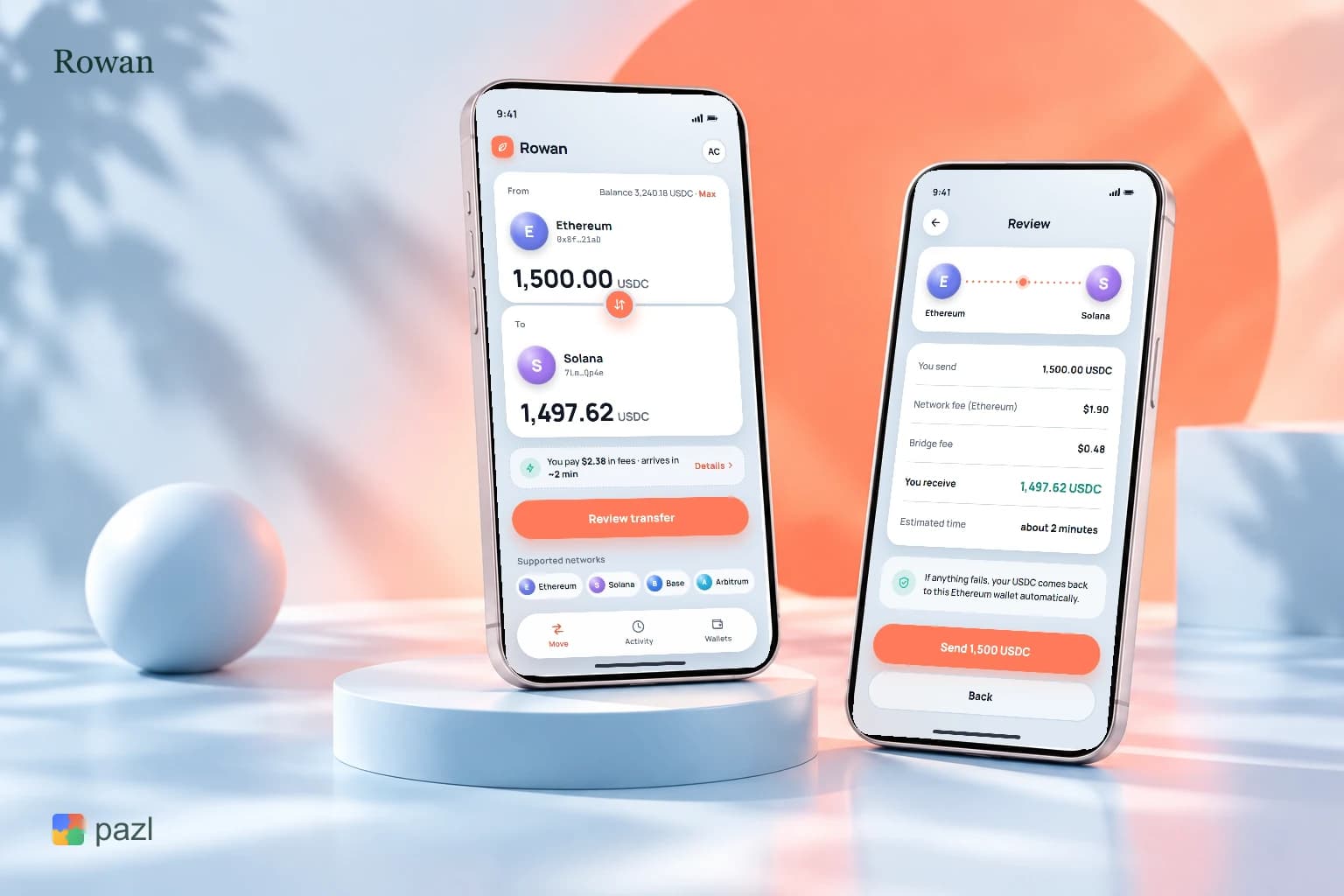
Concept Rowan: Cross-Chain USDC Transfers
01 Follow the money
From the on-ramp to your books.
Funds sit with your licensed providers; we build the software that connects them to your platform.
01 / 05On and off-ramp
Fiat comes in and goes out through a licensed provider, inside your app.
02 Delivered work
Real projects by the same team.
TeleCard is our own crypto wallet. We have no Web3 client project to show yet; the other projects are the same kind of work, built and shipped by the same team.
Customers ask for stablecoins. Your core wasn’t built for them.
Where fintech teams are when they call.
More
01A stablecoin pilot runs on a spreadsheet beside the ledger.
02The custody provider is chosen; nobody has wired it in.
03Compliance wants Travel Rule data the product doesn’t collect.
04The authorisation application needs a clear picture of the tech.
04 In the UK
Stablecoin rules are arriving. Design for them now.
The FCA, the Bank of England and the new authorisation window all shape how a stablecoin feature is built.
Starting pricefrom £1,900Fixed price for the agreed integration, set after the brief.
FCA · PS26/10Redemption by the next business dayBank of EnglandDraft rules for systemic sterling stablecoinsFCA · gatewayApplications close on 28 February 2027
Details and sources
Redemption by the next business day. Under the FCA’s stablecoin rules (June 2026), a UK-issued qualifying stablecoin must be redeemed with payment no later than the end of the business day after the issuer receives the request, and the backing assets are held on statutory trust for holders. Cut-off times belong in the redemption flow.
Draft rules for systemic sterling stablecoins. On 22 June 2026 the Bank of England published a policy statement and draft rules for systemic sterling stablecoins; non-systemic stablecoins will be supervised solely by the FCA. Which side your coin or provider falls on shapes the reporting you build.
Applications close on 28 February 2027. The FCA’s application window for the new regime opened on 30 September 2026 and closes on 28 February 2027, and firms already registered under the Money Laundering Regulations still need FSMA authorisation. A written system design helps your team describe the product.
No. Funds sit with your licensed custodian, stablecoin issuer or ramp provider, or with you if you hold the permissions. We build the software that connects them to your product.
Which stablecoins and chains?+
The ones your providers support and your customers use, typically on Ethereum, EVM chains such as Base or Polygon, or Solana. We decide with you and your providers, not from a list.
Can you help with our FCA application?+
We can describe the system’s design, data flows and controls for the technical parts of it. The application itself and the legal analysis stay with you and your advisers.
What does a fintech blockchain integration cost?+
A first integration, one provider and one flow such as stablecoin payouts, starts at £1,900. The fixed price for your scope follows the brief and a look at the providers’ APIs.
Do you need a licence for this work?+
No: we design and build software and hold no licence. The permissions sit with you or your providers, depending on who carries on each regulated activity. Your lawyer maps it; we build to it.
 pazlWEB3←Main site